
.svg)
.svg)


.svg)
.svg)
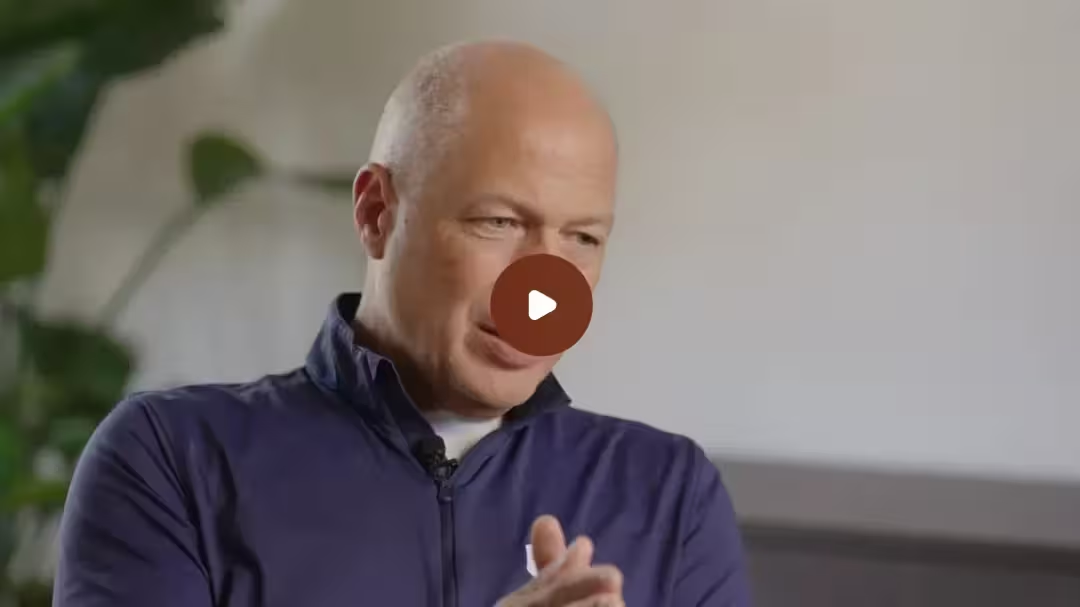
After 15 years working across private equity, John Henderson has learned to distrust neat assumptions about scale.

He’s advised on deals spanning continents and industries, first as a transaction services advisor at KPMG and later inside PE-backed portfolio companies, where he helped build M&A functions and lead exits totaling more than $1.5bn in enterprise value. Along the way, he’s seen football clubs, pharmaceutical firms, manufacturers, and technology businesses priced, structured, and dismantled in very different ways.
That perspective is what makes one of his opening observations on Next Exit so telling.
“I’ve done everything from maybe a five-million deal to a five-billion deal,” Henderson says. “And the most difficult deal I ever did was around a $10m EV deal.”
It’s a counterintuitive insight, and one that runs through the entire conversation with Dan Thompson, CEO of Kluster and host of Next Exit. Complexity, Henderson argues, doesn’t rise neatly with valuation. It accumulates in structure, regulation, operating maturity, and decision quality. And in today’s market, those factors matter more than ever.
Scale doesn’t equal simplicity
That same structural complexity is usually where the first cracks appear, not during negotiation, but in the fundamentals that underpin the business.
The instinct to associate larger deals with greater complexity is understandable, but often wrong.
Henderson’s hardest transaction wasn’t difficult because of ambition or risk appetite. It was difficult because of jurisdictional friction. A relatively small French business came wrapped in regulatory, legal, and tax complexity that far outweighed its size.
“The business itself was fantastic,” he recalls. “But the work around how you actually acquire it was hugely complicated for such a small business.”
By contrast, he’s worked on transactions hundreds of millions in size that were comparatively straightforward, precisely because they operated in familiar jurisdictions with repeatable deal structures.
The lesson for operators and investors is subtle but important: deal risk is structural, not numerical. It hides in the seams between systems, geographies, and governance, not in the headline enterprise value.
Why clean fundamentals decide outcomes long before diligence
Once those foundations are in place, the real differentiation shifts to how finance influences decisions before their impact shows up in the numbers.
Across Henderson’s career, from advisory work at KPMG to leading exits inside PE-backed businesses, one pattern repeats.
Deals rarely fail because the opportunity isn’t exciting. They stall because the foundations don’t hold up under scrutiny.
“You need really solid, clean financials,” Henderson says. “If there are red flags around audit, tax or compliance, that instantly comes up as a warning to any investor.”
This goes deeper than tidy management accounts. It shows up in billing accuracy, collections discipline, working capital management, and cash visibility. Henderson has seen fast-growing businesses lose momentum in diligence when basic questions around cash conversion or balance sheet movement couldn’t be answered cleanly.
“Revenue is vanity, profit is value, but cash is king,” he adds.
That perspective shapes how sophisticated finance teams operate today. The focus moves early toward forward-looking visibility, connecting operational signals to a live forecast, rather than relying on static snapshots that explain performance after the fact.
How finance decisions compound before results are visible
As those decisions accumulate, they increasingly shape how investors interpret performance and, ultimately, how businesses are valued.
In Henderson’s experience, the most effective finance leaders sit at the intersection of operations, commercial decision-making, and strategy. They understand how the business makes money, where it leaks value, and which decisions compound over time.
This shows up in everyday choices. How pricing decisions affect margin. Where product investment drives retention. Whether expansion into a new geography actually strengthens the core business.
These decisions often happen long before they appear in reported numbers. By the time they do, the outcome is largely set.
This is why boards increasingly expect finance leaders to provide coherence. Clear narratives, supported by consistent data, delivered through mechanisms like automated board reporting that allow directors and investors to focus on decisions rather than reconciliation.
Why valuation now exposes operating discipline
That shift in valuation logic places far greater pressure on how businesses manage cash as leverage re-enters the equation.
Henderson has watched valuation logic change in real time.
“Two or three years ago, revenue growth was seen as the gold standard,” he says. “What I’m seeing now is a push towards profitable growth.”
That shift reflects capital constraints, higher interest rates, and longer hold periods. Investors are underwriting businesses that can sustain growth without continuous external funding.
For operators, this reframes what “good performance” looks like. Revenue still matters, but its quality matters more. Margin structure, cost discipline, and the ability to convert growth into cash increasingly define how businesses are priced.
This places greater weight on accurate revenue recognition and margin visibility, particularly in SaaS and subscription-led models where timing and assumptions materially affect perceived performance.
How leverage turns cash flow into a leadership issue
With cash visibility comes a second-order challenge: knowing which signals actually reflect the health of the business.
As leverage re-enters the picture across private equity portfolios, cash flow moves from an operational concern to a management discipline.
Henderson consistently points to short-term cash visibility as a differentiator between businesses that stay in control and those that don’t.
“When you’re dealing with leverage, you need visibility on your quarter cash flows on a granular basis,” he explains, highlighting the importance of 13-week cash forecasting.
The detail matters. Invoicing cadence. Supplier terms. Tax payments. Bonus cycles. Advisory fees tied to M&A activity. These are predictable, but only if they’re actively modelled.
Businesses that maintain this visibility create options. Those who don’t find themselves reacting late often under pressure.
How the wrong metrics create false confidence
When those signals are misread or taken at face value, the most serious risks often surface too late to be managed.
One of the quieter risks Henderson sees in transactions comes from metric overload.
Different business models signal health in different ways. Early-stage SaaS businesses are assessed on ARR growth, churn, and market expansion. Capital-intensive businesses are judged on EBITDA quality, cash conversion, and capital efficiency. People-heavy services businesses hinge on retention and delivery capacity.
Problems arise when metrics are imported wholesale from one context into another.
Investors don’t expect perfection. They expect coherence. Metrics that align with how the business actually operates, and that reconcile cleanly back to source data.
Where deals really break
How those moments are handled often determines not just whether a deal survives, but whether trust does.
The most consequential risks Henderson has encountered rarely sit neatly in the P&L.
They tend to surface in the assumptions beneath it.
In one pharmaceutical deal, a regulatory ruling removed access to a core market and wiped out the majority of EBITDA overnight. The numbers were accurate. The business was performing. The risk sat outside the financial model, until it didn’t.
In another case, a truck leasing business reported more than €100m in EBITDA. On paper, it looked robust. In practice, it required over €120m of annual CAPEX just to sustain its fleet, quietly consuming cash year after year. The business wasn’t unprofitable. It was structurally constrained.
Neither issue was hidden. Both were visible to anyone who knew where to look.
These moments illustrate a recurring pattern in Henderson’s career. Deals don’t fall apart because information is missing. They fall apart because numbers are taken at face value, without interrogating the mechanics that sit behind them.
Diligence fails when understanding stops at the output.
Why credibility compounds when clarity comes early
In a market shaped by volatility and caution, that trust increasingly determines which assets continue to attract capital.
Surfacing risks like these rarely makes you popular in the moment.
When Henderson’s team flagged the regulatory exposure in the pharmaceutical deal, the reaction was immediate disbelief. The private equity firm had already spent weeks underwriting the opportunity. The conclusion challenged that work directly.
“They didn’t like the news,” Henderson recalls. “But later you got the sense they really appreciated it.”
The deal collapsed. The relationship strengthened.
In volatile markets, credibility compounds slowly and disappears quickly. Investors remember who helped them avoid losses just as clearly as who helped them close deals. Clarity, delivered early, becomes a form of trust capital.
This is particularly true in environments where uncertainty is structural rather than cyclical.
What still remains in today’s market
For many leadership teams, the remaining question is how to build that level of visibility before the market demands it.
Despite geopolitical volatility and suppressed deal volume, Henderson sees no shortage of capital waiting to be deployed.
“What I’m seeing is fewer deals, but larger deals,” he says. “For good quality assets, there is appetite.”
The distinction is quality. Investors are backing businesses that demonstrate operational discipline, financial visibility, and decision-making maturity. These companies give confidence that what is reported reflects how the business actually operates.
That confidence increasingly comes from how well finance teams can connect performance to forward-looking insight. Not just what happened, but what happens next, and why.
This is where platforms built for CFOs and private equity are starting to matter more. Not by producing more data, but by reducing uncertainty, tightening feedback loops, and enabling clearer, earlier decisions.
Building forecasting excellence
Forecasting excellence comes from linking operational reality to financial outcomes in a way that holds up under scrutiny. It allows risks to surface while there’s still time to act, and opportunities to be sized with confidence.
If you’re thinking about how to build that capability inside your own organisation, Kluster works with CFOs and private equity-backed teams to create connected, decision-ready forecasting that reflects how the business truly runs.
You can explore how that works in practice on Kluster’s forecasting platform, or speak with the team about building forecasting excellence inside your organisation.
.svg)
.svg)